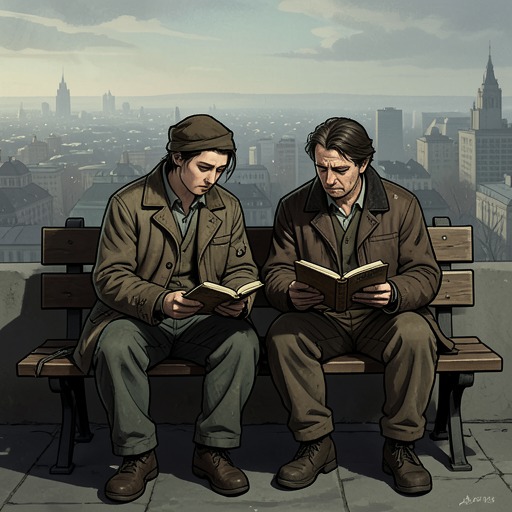
Kirsten Raymonde–August: traveling companions and close friends
Station ElevenKirsten Raymonde and August’s relationship is a close friendship shaped by life on the road: they share danger, watch over one another, and make practical decisions as a pair. When they become separated from the Travelling Symphony, their companionship provides immediate security in an uncertain landscape. Later, after violence has altered August’s experience of survival, they remain together and continue toward Severn City Airport. Their bond is shown less through declarations than through attentiveness, shared work, and the decision to keep moving side by side.
Companionship in Separation
Three days after Kirsten Raymonde and August are separated from the Travelling Symphony, they shelter behind a garden shed in an overgrown backyard outside Severn City. Kirsten wakes from a dream in which she had been walking with August, turned around, and found him gone and dead. The dream is not a premonition or an account of an actual loss: August is beside her, watching her, with a hand on her arm. His immediate presence counters the fear the dream has produced, while the fact that he too has had bad dreams makes the moment one of shared vulnerability rather than a one-sided rescue.
Their predicament gives this reassurance practical force. They are away from the group and do not know when they will find it again. August proposes that they wash because they may meet people that day, orienting their attention toward the next encounter rather than the previous night’s fear. Kirsten and August cross to the beach, wash, and take turns cutting one another’s hair with scissors from his suitcase. These small acts restore a degree of routine and mutual care amid dislocation. Neither can remove the danger or guarantee a reunion with the Travelling Symphony, but each can help the other prepare to face the day.
Care as Shared Practice
The scene presents their friendship through reciprocal tasks. Kirsten finds shampoo, washes her dress, and cuts August’s hair; August initiates the washing and cuts Kirsten’s hair in turn. The exchange is not framed as one companion permanently protecting the other. Instead, they alternate between proposing care and receiving it. Their supplies and circumstances are modest, but the acts make their partnership concrete: they attend to one another’s immediate needs while adapting to a world in which familiar services and social structures are absent.
Afterward, they abandon their wheeled suitcases because the wheels are too loud on the rough pavement. They make bundles from bedsheets and carry their supplies over their shoulders, moving quietly through the overgrown streets. The choice reflects a shared approach to risk: practical necessities are reorganized around the conditions they face, and both take part in the work of continuing. When August reassures Kirsten that they will find the others, his confidence gives their joint journey a near-term aim. It does not resolve their separation; it helps them proceed despite it.
Violence and Its Cost
The relationship is tested again during the Travelling Symphony’s encounter with armed men outside Mackinaw City, two years later. Kirsten recognizes the threat as the men demand food, horses, and a woman. The Symphony’s archer signals for the men with guns to be dealt with first, and August shoots one of them. The other gunman falls to Kirsten’s knife, while the Conductor kills the remaining attackers. The group retrieves the weapons and leaves the bodies in the forest before going into Mackinaw City to perform Romeo and Juliet.
For August, the encounter marks a change: the gunman is the first person he has killed, and he had reached Year Twenty without having killed anyone. Kirsten sees his expression afterward and understands the significance of this first killing for him. She has hoped there would never be a third such encounter, and she recognizes that surviving violence does not leave a person unchanged. Yet she is exhausted and struggling to breathe through the force of Sayid’s terrible news; she cannot give August the understanding she has arrived at. Their closeness therefore does not make either of them invulnerable, nor does it mean that they can always comfort each other at the moment comfort is needed. Kirsten perceives what the experience may cost August, even as her own grief limits her ability to say so.
Continuing Together
After the confrontation, Kirsten and August remain among the group as it walks toward the airport, stunned by grief and largely silent. The road leads them away from the lake and through residential streets, past deteriorating houses and cars left behind by the old world. Their silence is not evidence that their bond has ended; it sits alongside their continued shared movement and the attention Kirsten pays to August’s response to the killing. The landscape offers beauty amid ruin, but it does not undo the losses or the consequences of their actions.
When Kirsten later kneels beside the dead Prophet, August is crouched at her side, speaking gently and explaining the plan: the Travelling Symphony is only a few hours behind them; Viola and Jackson will return to the group, while he and Kirsten will go ahead to the airport. The arrangement places the two friends together again, now moving ahead of the larger company rather than trying to catch it from behind. August’s presence beside Kirsten, and his role in calmly orienting her toward what happens next, echo the earlier moment when his hand on her arm brought her out of a frightening dream. Across both moments, his care takes the form of presence and practical direction, not a promise that danger or grief can be prevented.
The Shape of the Friendship
The evidence of Kirsten Raymonde and August’s friendship is made up of repeated acts of companionship under changing conditions: sheltering together when separated from the Travelling Symphony, helping one another wash and cut their hair, carrying supplies in a quieter and more manageable way, and proceeding together after an encounter that leaves August newly marked by violence. Their relationship is neither presented as a cure for trauma nor reduced to a single dramatic declaration. It enables them to share the burdens of travel, but each still confronts fear and loss in a personal way.
The contrast between the dream of August’s death and his later survival beside Kirsten gives their continued companionship particular weight. At the moment of waking, Kirsten’s fear is answered by the reality of his hand on her arm; later, she recognizes that surviving an actual violent encounter may still change him. The friendship holds both facts together: presence can reassure, but it cannot erase what has happened. Their movement toward the airport preserves the bond not as a guarantee of safety, but as a continuing practice of caring for one another and choosing the next step together.